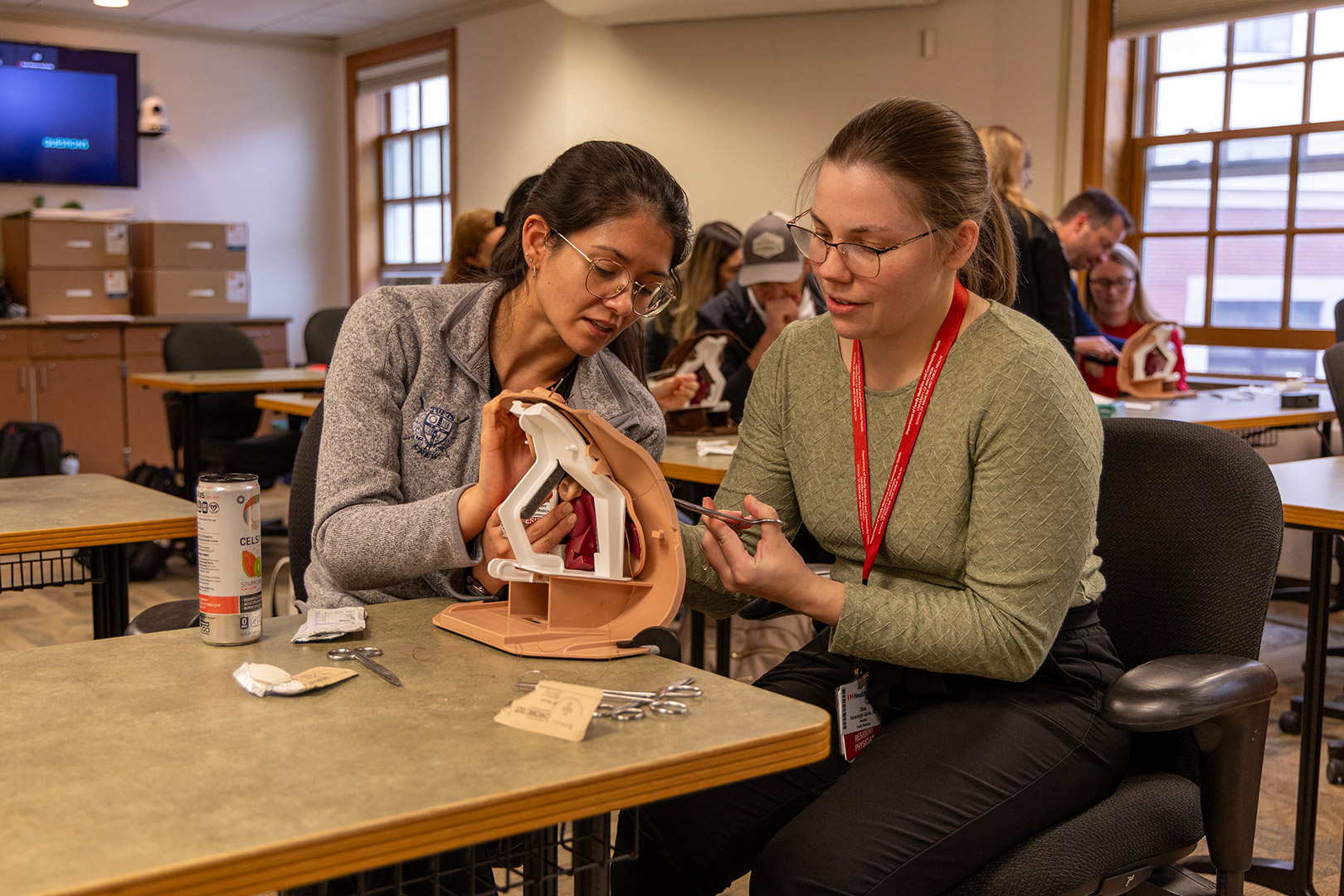
Clinical and Elective Rotations
Our curriculum prepares residents for full-spectrum family medicine through longitudinal continuity of care and diverse clinical experiences. Under the guidance of experienced faculty, residents build the skills, confidence, and clinical judgment needed to care for patients across the lifespan while taking on increasing responsibility within care teams.
Training is individualized to support residents’ interests and career goals, with strong mentorship and curricular flexibility. Graduates are well prepared for a variety of family medicine practice environments.
Curriculum and Block Schedules
Our program utilizes a block schedule consisting of 16 three-week blocks per academic year. Vacation time is built into the schedule and increases over the course of training. Residents receive three weeks of vacation during the first year of residency. During the second and third years, residents receive four weeks of vacation, consisting of three full weeks and five flexible vacation days.
Curriculum
First-year residents train within a partnership model pairing residents from the same clinic to support one another during shared inpatient and community-based rotations. The PGY1 year provides broad exposure to adult medicine, pediatrics, obstetrics, emergency medicine, surgery, and community health across academic, community, and rural settings, with required outpatient experiences scheduled early whenever possible to preserve flexibility and elective time later in training.
The first year of residency is designed to be an intensive, inpatient-focused experience with limited elective time. Residents build critical skills in adult medicine, obstetrics, pediatrics, emergency medicine, and surgery — laying the groundwork for future autonomy.
Core Rotations
- Adult Medicine – St. Mary’s Family Medicine Service – 2 blocks
- Adult Medicine – UW Hospital Family Medicine Service – 1 block
- Adult Medicine – Medical Intensive Care Unit at St. Mary’s Hospital – 1 block
- Pediatrics Service at St. Mary’s Hospital – 2-3 weeks
- Pediatric Service at American Family Children’s Hospital – 3-4 weeks
- Pediatrics/Family Medicine Night Cross Coverage – St. Mary’s Hospital – 1 block
Women’s Health and Obstetrics
- Obstetrics – St. Mary’s Hospital – 2 blocks
- Family Medicine Obstetrics and Newborn Service – Meriter Hospital – 1 block
Procedural and Acute Care
- Emergency Medicine – Community Emergency Departments – 1 block
- Sites include St. Clare’s Hospital – Baraboo, Upland Hills Health – Dodgeville, Sauk Prairie Healthcare – Sauk, St. Mary’s Hospital – Madison
- Rural Surgery Preceptorship – 2-3 weeks
- Sites include St. Clare’s Hospital – Baraboo, Upland Hills Health – Dodgeville, Stoughton Health – Stoughton
Outpatient Rotations
- Nutrition – 1 week
- Newborn – Outpatient – 1 week
- Pediatrics – Allergy or Pediatrics – Urgent Care – 1 week
- MSK-Ortho (MDs only) – 1 week
- Community Health – 3 weeks
Vacation
- 3 weeks
Curriculum
During the second year of training, residents build on their clinical foundation through expanded inpatient and night float experiences, continued pediatrics and obstetrics training, and increased responsibility on family medicine services. Residents complete a required rural rotation at a Wisconsin practice site and continue outpatient and community-based experiences. Dedicated time for continuing medical education and vacation is built into the schedule.
Year two shifts to more outpatient care, leadership opportunities, and teaching experiences for residents with growing flexibility to tailor their education. Residents begin to supervise inpatient teams and participate in a rural rotation and community health work.
Core Rotations
- Medical Intensive Care Unit – St. Mary’s Hospital – 1 block
- Night Float – St. Mary’s Hospital – 2 weeks
- Family Medicine Service – UW Hospital – 1 block
- Night Float – UW Hospital – 2 weeks
- Pediatrics Service – St. Mary’s Hospital – 1 block
- Family Medicine Obstetric and Newborn Service – Meriter Hospital – 2 blocks
- Required Rural Rotation – Wisconsin rural practice site – 3-4 weeks
- Site options include Beaver Dam, Dodgeville, Lancaster, Menominee Tribal Clinic, Richland Center, Sauk, Viroqua, and Watertown
- Continuing Medical Education (CME) – 1 week
- Community Health – 1 week
- Outpatient rotations (elective & required)
Vacation
- 4 weeks
Curriculum
In the final year of training, residents assume greater clinical responsibility on family medicine inpatient services and night float rotations, with continued obstetric experience across hospital sites. The year emphasizes preparation for independent practice through outpatient continuity, elective opportunities, community health engagement, and protected time for continuing medical education and vacation.
Year three offers the most elective time, allowing residents to focus on individual interests and prepare for their future practice. Hospital rotations decrease while outpatient and specialty-focused electives expand.
Core Rotations
- Family Medicine Service – St. Mary’s Hospital – 1 block
- Night Float – St. Mary’s Hospital – 2 weeks
- Family Medicine Service – UW Hospital – 1 block
- Night Float – UW Hospital – 2 weeks
- OB Float – St. Mary’s Hospital and Meriter Hospital – 1 block
- Continuing Medical Education (CME) – 1 week
- Community Health – 1 week
- Outpatient rotations (elective & required)
Vacation
- 4 weeks
Requirements and Electives
During outpatient rotations — both required and elective — residents maintain continuity clinic participation while gaining focused ambulatory experience. Residents are generally scheduled for four half-days per week in their continuity clinic, five half-days per week in the outpatient rotation, and one half-day per week dedicated to family medicine seminars.
Required outpatient rotations are outlined below and are designed to ensure broad exposure while allowing flexibility for individualized learning goals.
Required Rotations
- Clustered Didactics – one week each in years two and three
- Second year topics: gynecology, management of health systems, geriatrics/palliative care, and men’s health
- Third year topics: musculoskeletal, addiction medicine, and nutrition
- Dermatology – 1 week
- ENT – 1 week
- Geriatrics/Palliative Care – 4 weeks
- Gynecology – 4 weeks
- Management of Health Systems – 1 week each in years two and three
- Musculoskeletal (MD residents only) – 1 week
- Nutrition – 1 week
- Orthopedics – 2 weeks
- Pediatrics – 8 weeks
- Includes Newborn/Lactation Counseling
- Rheumatology – 1 week
- Sports Medicine – 3 weeks
Residents have a minimum of 26 weeks of elective time built into the curriculum. A wide range of established electives is available, and residents may also design individualized or longitudinal electives to align with personal interests, career goals, and practice plans.
Electives
- Addiction Medicine
- Allergy
- Behavioral Health
- Cardiology
- Clinical Skills Teaching
- Diabetes Management
- Direct Primary Care
- Endocrine
- Federally Qualified Health Center (FQHC)
- Gender Care
- High-Risk OB
- Hospice
- Hospitalist
- Integrative Health
- Lactation
- Migrant Mobile Health Clinic
- Neurology
- NICU / Neonatal Resuscitation
- Nutrition
- OMT for MDs
- Ophthalmology
- Out-of-Town / International
- Palliative Care and Hospice
- Practice Styles
- Procedures
- Psychiatry
- Pulmonology
- Radiology
- Research
- Resident as Teacher
- Urgent Care
- Urology
- Vasectomies
- Weight Management
- Wound Care
Behavioral health is a longitudinal and integrated component of the curriculum. Training emphasizes a biopsychosocial and integrative approach to care, supporting patient-centered, relationship-based family medicine. Residents learn to address the emotional, psychological, and social dimensions of health through team-based care, collaborating closely with behavioral science, family medicine physician, nurse practitioner, and physician assistant faculty across clinical sites.
Community health is a longitudinal component of the curriculum that prepares residents to practice patient- and community-centered family medicine. Through structured programming and protected time across all three years, residents learn to engage with community partners, understand local health resources, and address health needs specific to their clinic populations. Residents may develop individualized learning plans and community-based projects with support from faculty, the Office of Community Health, and community partners.
Additional educational requirements include the weekly Primary Care Conference or Journal Club, and family medicine seminars with a broad curriculum inclusive of the full spectrum of family medicine. There are also weekly resident-led teaching sessions and an EKG teaching series.
Parenting During Residency
Pregnancy and parenthood are common and supported within the residency. The program provides paid parental leave, flexible scheduling options, and dedicated educational opportunities to support residents during pregnancy, parental leave, and the transition back to clinical training. Accommodations are available to support lactating residents and promote wellness throughout residency.
Resident Support
Resident well-being is a priority of the program and is supported through intentional community-building, protected time for connection, and accessible leadership. Residents participate in regular social, reflective, and wellness-focused activities designed to foster support, resilience, and connection throughout training. Faculty, chief residents, and program leadership maintain an open-door approach and are actively engaged in supporting residents’ professional growth and quality of life.
Curriculum to Fit Your Interests
Our People
Our Training Sites
Contact Us
Questions about applications and interviews can be sent to: dan.samuelson@fammed.wisc.edu